
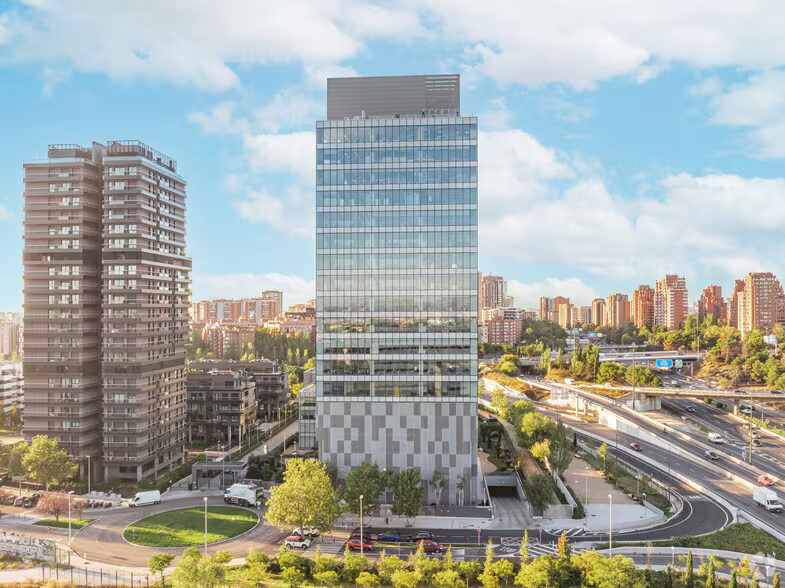
The traditional concept of the office has changed forever. Following the pandemic and the consolidation of hybrid work, Spain has surpassed the barrier of one million square meters dedicated to coworking spaces. At the forefront of this revolution is Madrid, which already accounts for a third of the national supply with more than 337,000 square meters. However, the big news of this 2026 is not happening in the center of the capital, but on its outskirts.
The evolution of the flexible office
We are no longer just talking about shared desks for freelancers or startups. The Madrid market has become highly professionalized, reaching an average occupancy of 84%. According to sector data and the Spanish Coworking Association (ACW), the keys to this success are:
- Diversity of tenants: Freelancers and SMEs coexist with branches of international companies and large corporations.
- New formats: Private offices and custom-managed offices have gained significant ground against the traditional “open space”.
- Corporate services: Today, companies demand high technology, sophisticated meeting rooms, and impeccable operational management.
The leap beyond the M-30
Although the financial axes (Castellana-Azca and Cuatro Torres) and transforming areas like Méndez Álvaro remain prime zones, 12% of coworking spaces are already making their way outside the central core in neighborhoods like Arturo Soria. What are companies looking for when moving away from the center?
- Accessibility and convenience: Ease of parking and the possibility of locating the office near the residential areas where the talent lives.
- Larger surface areas: In the periphery, it is easier to find entire floors or adaptable buildings for large teams.
- Professional synergies: Spaces that allow for sharing expensive services and fostering networking away from the hustle and bustle of the center.
The outskirts: the half-price solution
Decentralization is unstoppable. The future of the sector points directly to peripheral municipalities such as Las Rozas, Alcorcón, or Móstoles, which are emerging as the next major hubs for openings for national operators.
In these towns, companies find an unbeatable competitive advantage: cost. While prices in the center are becoming increasingly prohibitive, in the outskirts the price per desk ranges between 140 and 220 euros per month per person, cutting the bill practically in half without compromising on quality.
Flexibility has become the norm, and being in the geographic center is no longer an indispensable requirement for business success.